 LayMesh
.lay language and feature reference#
This page documents the executable syntax of the current Rust engine. Read a layout as canvas → reusable definitions → placements → export. Complete source files and actual output are in examples and results. The LayMesh parser interprets .lay; Python and JavaScript do not execute it.
1. Files, values, and units#
An entry .lay file must define exactly one canvas(...). Constructors return reusable material definitions; page.add(...) returns a placed instance. Only instances have page anchors. Strings support single/double quotes and triple-quoted forms; formulas often use raw r"..." strings to preserve backslashes. # begins a line comment. Calls use parentheses and commas; indentation does not affect meaning.
| Syntax | Meaning |
|---|---|
12, true, false, "Title" |
Scalar, boolean, and string values |
12 mm, 1.2 cm, 0.5 in, 10 pt |
Lengths, stored internally as mm |
16 px |
Length converted using canvas layout_dpi, default 96 |
45 deg, or 45 on placement |
Degrees of rotation |
(x, y), [a, b], items[0] |
Tuples, lists, and zero-based indexing |
+ - * /, comparisons, and or not |
Unit-aware arithmetic and boolean expressions; and/or short-circuit |
Lengths of the same type can be added or subtracted. Multiplying or dividing by a scalar preserves a length; dividing two lengths produces a scalar. Incompatible types, division by zero, and out-of-range values are errors. px requires a canvas layout_dpi. PNG export --dpi is independent of layout layout_dpi.
Canvas: canvas#
page = canvas(name="Figure 1", size=(180 mm, 120 mm), layout_dpi=96, background="#ffffff")| Parameter | Meaning and default |
|---|---|
size |
Required pair of positive lengths (width, height); physical SVG/PDF page size |
name |
Optional Scene name; default "Untitled" |
layout_dpi |
Positive number, default 96; affects layout px and unsized images |
background |
#RGB/#RGBA/#RRGGBB/#RRGGBBAA, rgb(...), hsv(...), oklch(...), or "none"; transparent by default |
The canvas variable may have any name. PNG dimensions use round(mm × dpi / 25.4) on each axis. The 180 × 120 mm basic example produced 2126 × 1417 px at 300 DPI.
2. Material constructors#
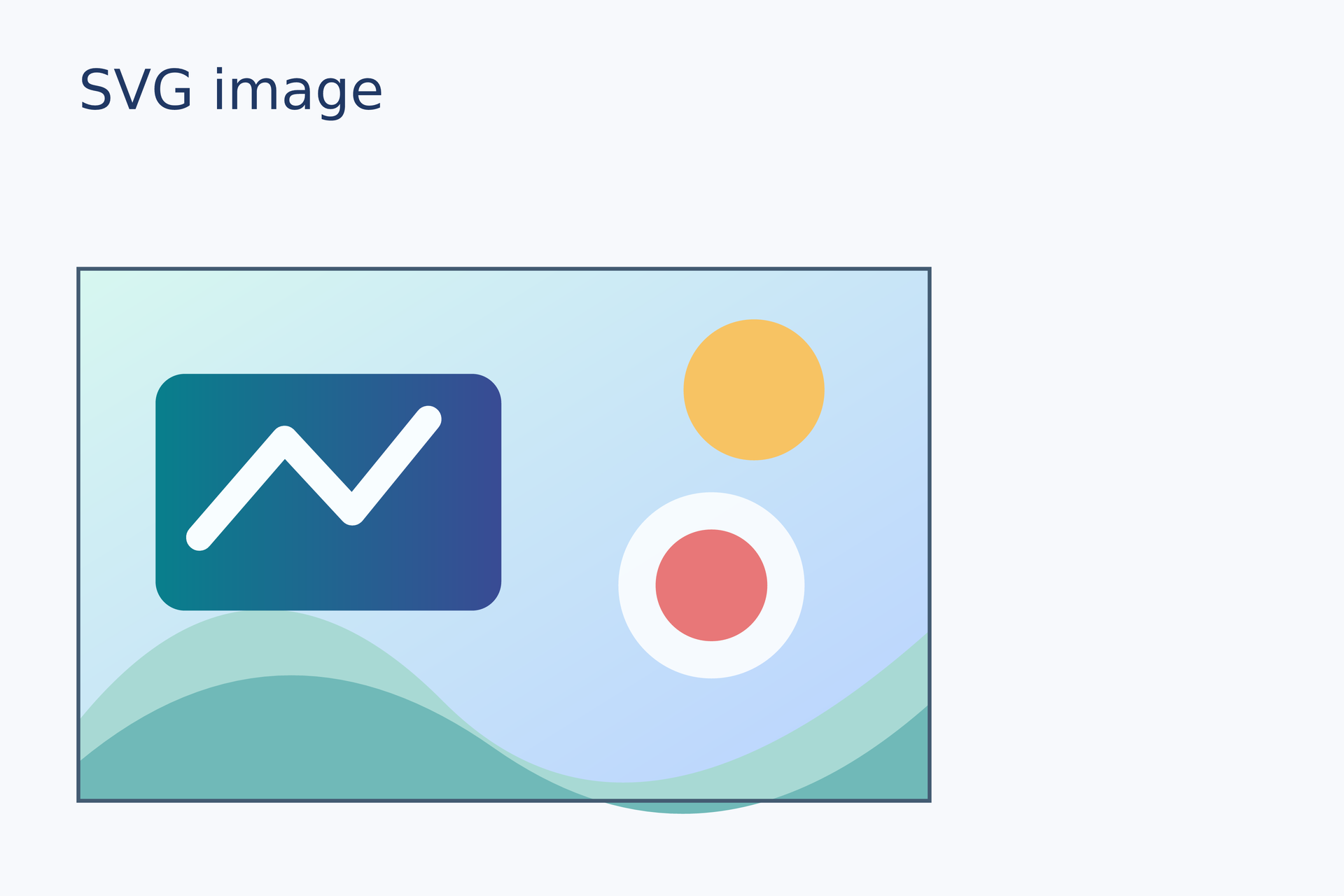
Asset paths below resolve relative to the .lay file that defines the material, including imported modules. Unless specified otherwise, a material can be placed repeatedly.
| Function | Required | Options and behavior | Example |
|---|---|---|---|
image |
src="..." |
PNG, JPEG, BMP, WebP, GIF, ICO, PNM, TGA, safe SVG, single-page unsigned 8/16-bit grayscale/RGB TIFF (optional alpha); normalized when loaded | basic |
text |
Either content="..." or spans=[...]; font_size=10 pt |
font_family, font_weight=400, font_style="normal", color="#000000", line_height, size=(80, auto), align=left |
typography |
span |
First positional argument is text | Only inside text(spans=[...]); may override font_family, font_size, font_weight, font_style, color |
typography |
formula |
source=r"...", font_size=10pt |
`style=inline | display, math_font="ratex-katex"`; standalone or text span |
rect |
size=(width, height) |
fill="none", border_radius=0, stroke settings |
outlines |
ellipse |
size=(width, height) |
Fill and stroke settings; no nonzero corner radius | basic |
line |
dx/dy or length/angle |
Full logical centerline; zero length requires explicit angle; independent caps and head(...) configs; default width 0.3pt |
Endpoints |
group |
None | Populate through g.add(...); can nest and be placed repeatedly |
scripted |
font_weight must be an integer from 100 to 900. align is left, center, right, or justify. With a width, text wraps at Unicode line-break opportunities and long words at grapheme boundaries; \n forces a break. Without width, it stays on one line except explicit breaks. A placement width can reflow the same material independently. The typography example demonstrates fonts, colored spans, inline formulas, and display formulas.
font_family accepts a system family, a TTF/OTF path, or a TTC/OTC face such as "fonts/collection.ttc#PostScriptFace". Ordered lists fall back per grapheme cluster. Missing glyphs produce measured squares with located W_FONT warnings and do not stop export. Variable fonts currently use a static substitute. RaTeX uses math_font="ratex-katex"; legacy mathjax-* names warn and map to that default. Body fonts are never bundled. Custom macros, \require, and external resources are rejected.
Vector constructors#
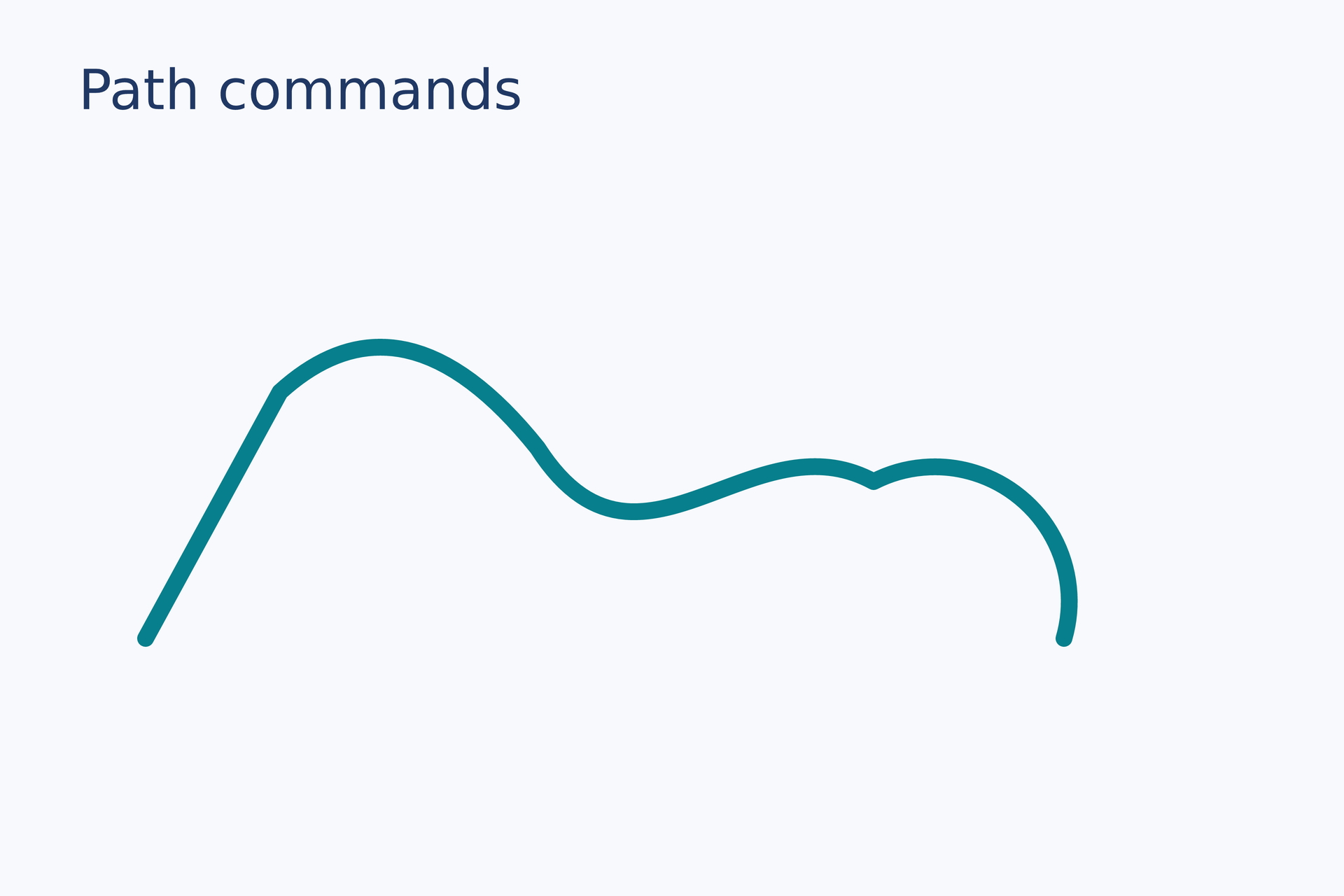
These accept fill, fill_rule=nonzero|evenodd, and stroke settings. polyline and arc default to no fill with a black stroke. Coordinates, radii, and points are lengths; angles may use deg.
| Function | Geometry parameters | Behavior |
|---|---|---|
path |
commands=[move_to(...), ...] |
Begins with move_to; multiple subpaths and holes; at most 10,000 commands. Example |
polygon |
points=[(x,y), ...] |
At least three points; closes automatically |
polyline |
points=[(x,y), ...] |
At least two points; stays open |
arc |
radius, start, end |
Open arc, span greater than 0 and less than 360° |
sector |
radius, start, end |
Closed sector |
star |
points, outer_radius, inner_radius, optional rotation |
3–1000 tips; inner radius smaller than outer |
ring |
outer_radius, inner_radius |
Transparent inner hole using even-odd fill |
The commands inside path(commands=...) are:
| Command | Positional arguments | Meaning |
|---|---|---|
move_to |
x, y |
Start a subpath |
line_to |
x, y |
Straight segment end |
quad_to |
cx, cy, x, y |
Quadratic control point and end |
cubic_to |
c1x, c1y, c2x, c2y, x, y |
Cubic control points and end |
arc_to |
rx, ry, rotation, large_arc, sweep, x, y |
Elliptical arc; flags are booleans |
close |
None | Close the current subpath |
Colors, gradients, and outlines#
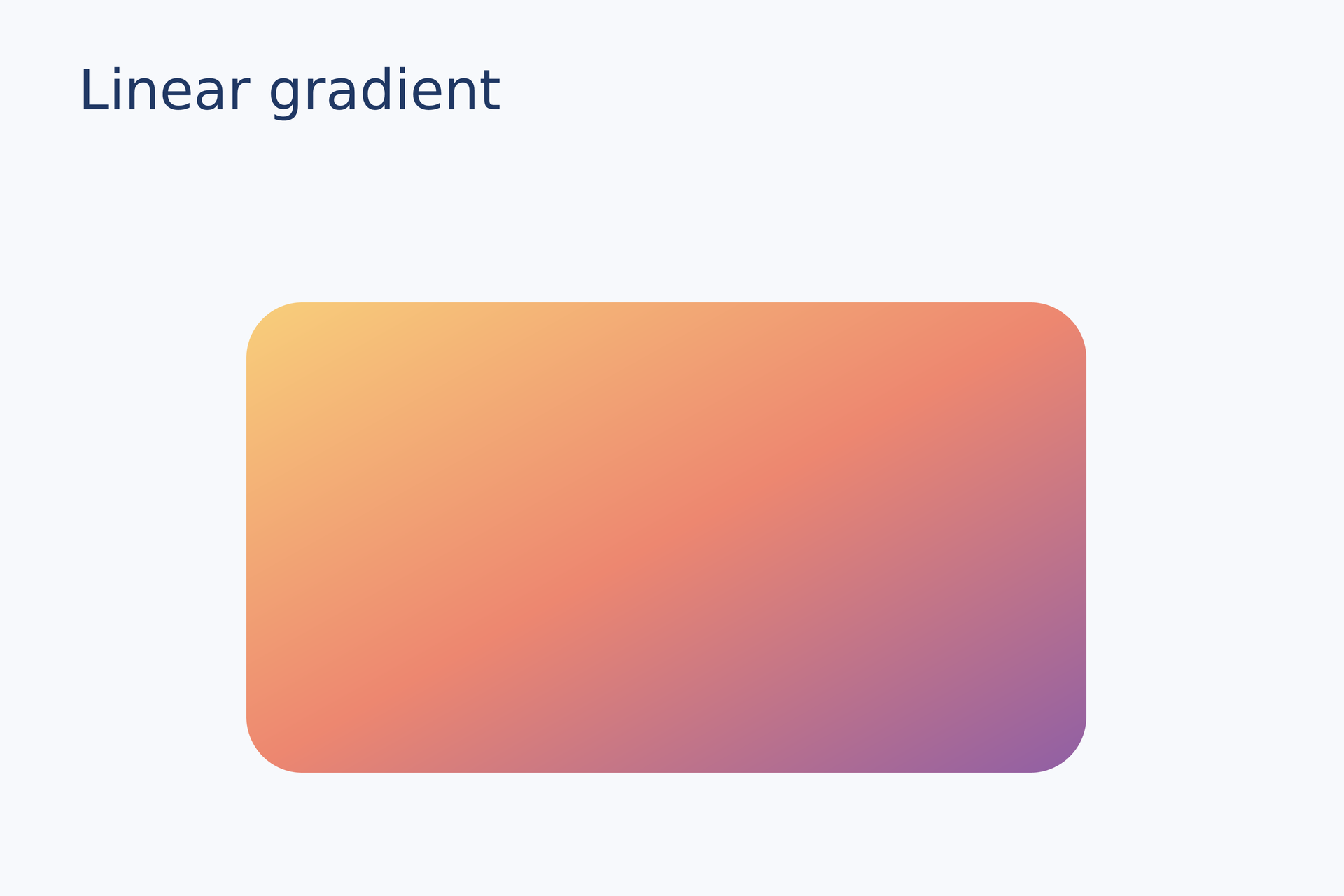
fill accepts #RGB/#RGBA/#RRGGBB/#RRGGBBAA, rgb(...), hsv(...), oklch(...), "none", linear_gradient(...), or radial_gradient(...). A stop is (position, color) or (position, color, opacity), with position and opacity in 0–1. Linear defaults to start=(0,0) and end=(1,0); radial defaults to center=(0.5,0.5), radius=0.5. Gradient coordinates are proportional to the placement bounds. See the vector example.
card = rect(size=(42 mm, 22 mm), fill="#e7f6f6", border_color="#087f8c", border_width=1.8 mm, border_style=double, border_dash=[4 * (1.8 mm), 2 * (1.8 mm), 0.01 * (1.8 mm), 2 * (1.8 mm)], border_cap="round", border_opacity=0.8)Closed outlines use border_color/width/style/dash/cap/join/opacity; open lines use the corresponding line_* names. Styles are solid/dashed/dotted/dash_dot/double/triple/none; double/triple gaps remain transparent. Reuse styles with LCSS classes; outline() is removed. See themes and fills.
3. Placement, anchors, groups, and fusion#
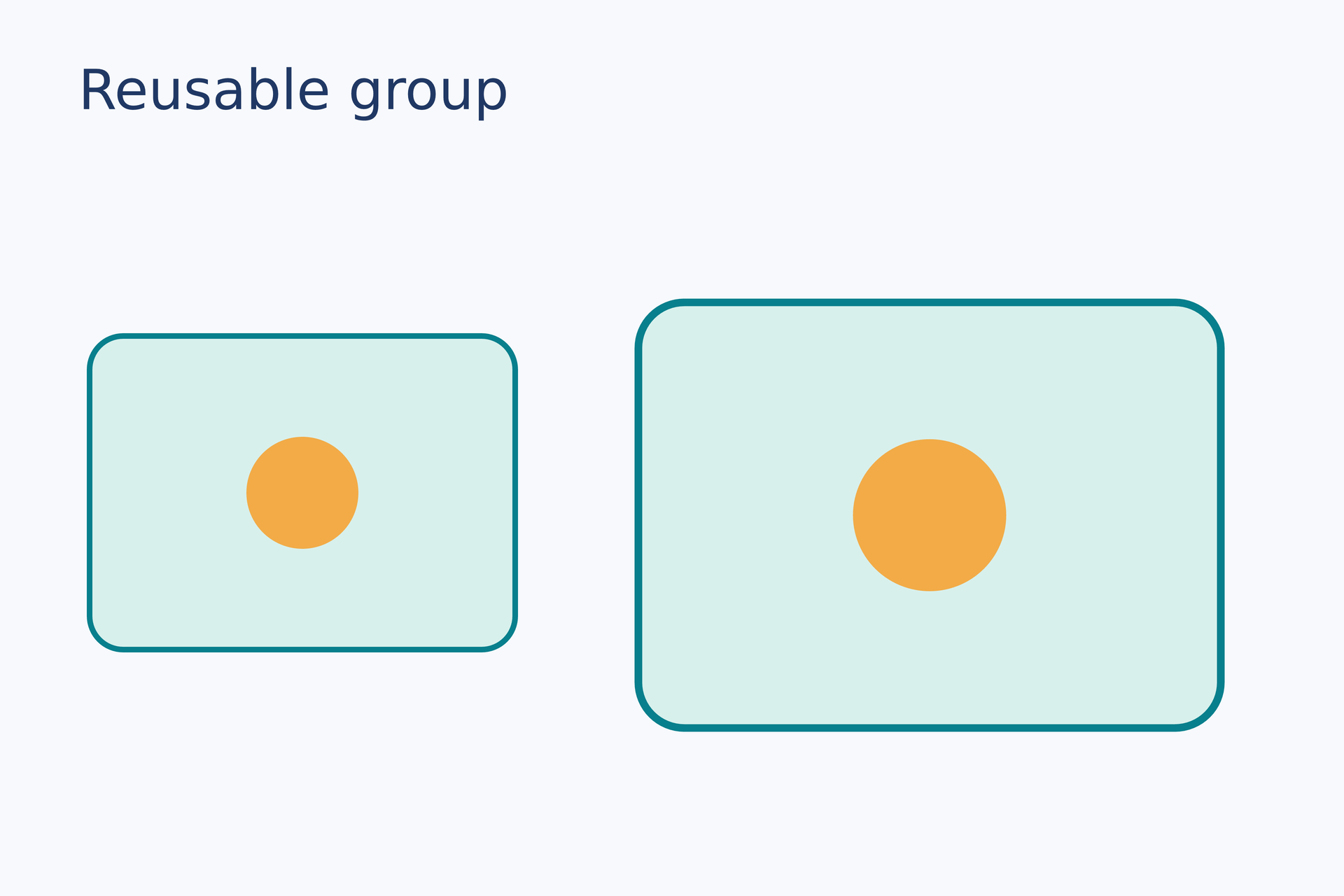
first = page.add(photo,size=(80 mm, auto), target=page.top_left, offset=(8 mm, 12 mm))second = page.add(photo,size=(40 mm, auto), anchor=top_left, target=first.top_right, offset=(4 mm, 0 mm))canvas.add(material, ...) and group.add(material, ...) return placements. An unused result can be written as a bare page.add(...) statement. Common settings are anchor (default top_left), target (the current container's top-left by default), offset=(0 mm,0 mm), rotation=0, and opacity=1. Later calls draw over earlier ones. Nine anchors are top_left/top_center/top_right, middle_left/center/middle_right, and bottom_left/bottom_center/bottom_right. These anchors use the rotated axis-aligned bounding box. A target must already exist in the same canvas or group. Within a group, group.top_left is its local origin.
Explicit instance.bounds/path/ink views support indexed candidate queries, self source selectors, arc-length and parameter points, tangent-frame offsets and chart components. See geometric anchors and path locations.
Lines expose instance.start/end and support placement with anchor="start"/"end". Native plots expose nine data-rectangle anchors prefixed with plot_, plus instance.data(x=...,y=...) data anchors; for example, anchor="plot_top_left" or target=chart.plot_center. These anchors rotate with their instances. See fixed data area and annotations.
| Material | Additional add options |
Rule |
|---|---|---|
| Image | size=(width, height), `fit=contain |
cover |
| Text | size=(80, auto) |
Rewrap this placement without changing the definition |
| Native plot | size=(width, height) |
Reflow the outer frame while preserving fonts, strokes and markers; plot_area also preserves the data rectangle |
| Rectangle, ellipse, path, group | size=(width, height) |
Scale the placement; group children scale together |
| Formula, line | No size override | Common options still apply |
Groups use local coordinates. Placing a group seals its contents; the same group can still be placed again. Nesting is limited to 128 levels and a group cannot contain itself. Crop precedes fitting: contain preserves the full image, cover clips overflow, and stretch may distort aspect ratio.
page.fuse(a, b, ...) or group.fuse(a, b, ...) combines two already placed vector instances in the same container into a new path. Set points=(a.anchor,b.anchor) to select connection anchors; omit it to use nearest visible-outline points. A gap requires positive bridge_width. junction=miter|bevel|round; round requires radius. The result uses fill and border_* settings; it can also set stroke options, fill_rule, and opacity. Both inputs leave the draw order and can no longer be referenced, while other placements of the same definitions stay intact. Images, text, and groups cannot be fused. See vector.lay.
With an ellipse or free curve, explicit anchor points must actually touch both visible outlines. A bounding-box anchor such as middle_right can be outside a concave curve. If a round junction encounters such a detached point, LayMesh returns a located E_FUSE; omitting points lets the engine select nearest visible-outline points. The straight-edge and free-curve examples show angled connections. Fused paths default to even-odd fill to preserve holes; an explicit fill_rule takes precedence. See the hollow edge and hollow corner examples.
4. Scripting and built-ins#
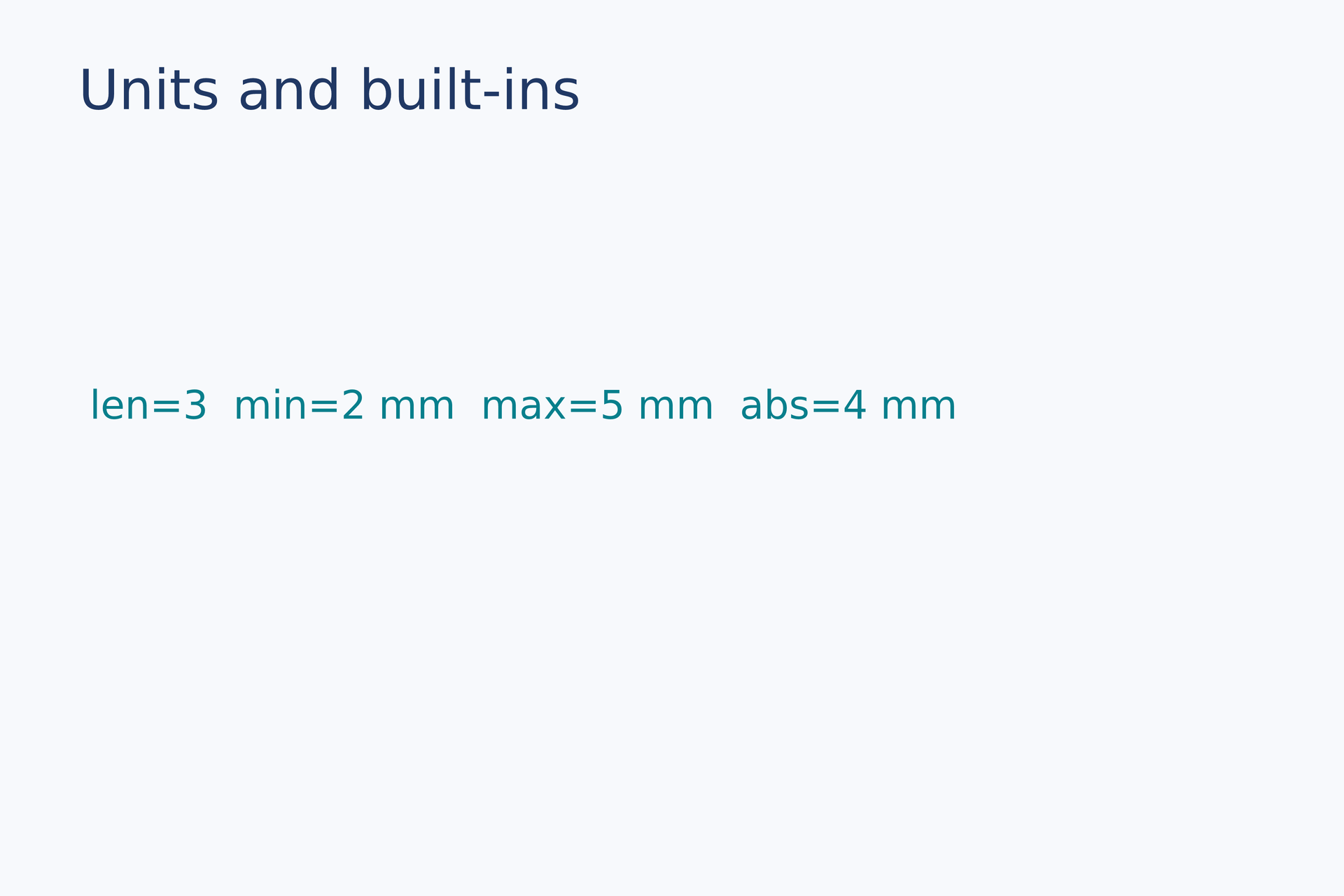
function twice(value, factor=2) { return value * factor }count = 0for index in range(3) { count = count + 1 }if count == 3 { gap = twice(2 mm) } else { gap = 1 mm }The language supports assignment and reassignment, if / else if / else, for ... in ..., while, break, continue, function, and return. Functions have lexical scope and optional default parameters. New variables in branches or loops are local; assigning an existing outer variable updates it. Conditions must be booleans. Canvas and placement .width/.height are read-only lengths. Limits: 10,000 iterations per loop, 64 function-call levels, and 1,000,000 executed statements.
| Built-in | Result |
|---|---|
range(stop), range(start,stop[,step]) |
Integer list excluding stop; nonzero step; at most 10,000 items |
len(list_or_string) |
List or string length |
append(list,value) |
New list; does not mutate the original |
str(value) |
Number, boolean, or string to text; lengths include mm |
abs(number) |
Absolute value preserving unit type |
min(a,...), max(a,...) |
At least one numeric value; compatible unit types required |
5. Local component modules#
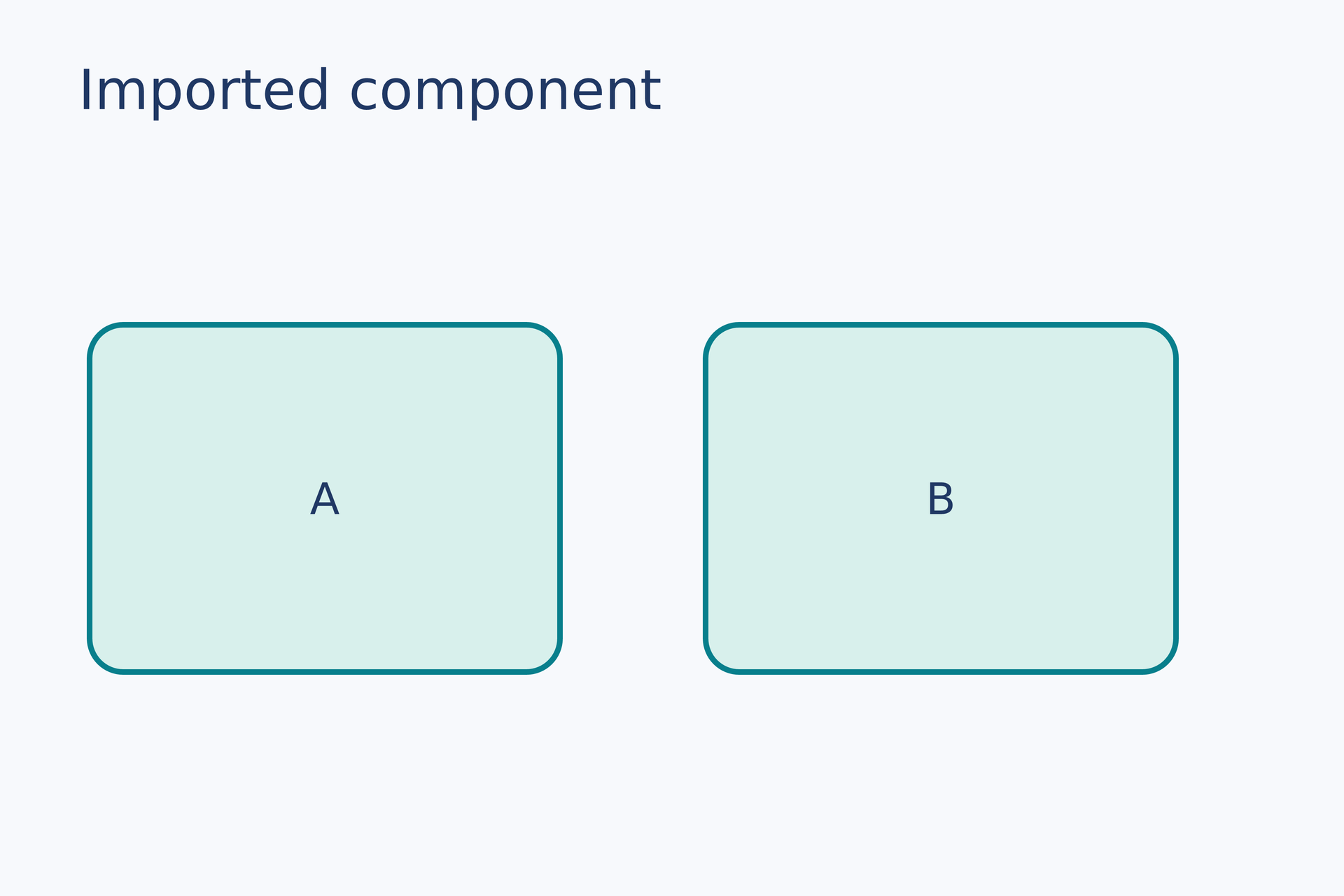
import { card, gap as spacing } from "./components/card.lay"page = canvas(size=(180 mm, 120 mm))tile = page.add(card("Example"), target=page.top_left, offset=(spacing, spacing))Imports must be local relative .lay paths. Modules use export for constants, materials, groups, or functions and may import further modules; imported names are read-only. The entry canvas must exist before imported values are used. A component module cannot create or draw on the entry canvas. Missing exports and import cycles are errors. See scripted.lay and card.lay.
6. Export and diagnostics#
laymesh validate <file.lay>laymesh inspect <file.lay> --jsonlaymesh render <file.lay> -o <output.svg|pdf|png> [--dpi <positive-number>]In this repository, prefix the commands with cargo run --release --locked -p laymesh-cli --. validate checks syntax, names, units, imports, image/font loading, glyph coverage, and placement constraints. render checks the same conditions before writing. --dpi applies only to PNG and defaults to 96. Errors report file:line:column: E_CODE: reason and return nonzero; warnings such as W_FONT, W_MATH_FONT, and W_PLOT_LAYOUT go to stderr without necessarily failing validation. CLI usage errors exit 2; layout/export errors exit 1.
SVG retains editable paths and ordinary <text>; PDF retains vector graphics and embedded ordinary text while storing formula LaTeX source; PNG rasterizes the same Scene. SVG input is allowlisted and rejects scripts, external links, DTDs, filters, and unsupported effects with E_SVG. PNG/JPEG/TIFF inputs are normalized to sRGB PNG for the Scene; TIFF is limited to single-page 8-bit grayscale or RGB. See actual output and failure examples and the feature gallery.
inspect --json exposes plot geometry, mappings, transformations and all diagnostics. Each command accepts --warnings show|hide, overriding LAYMESH_WARNINGS (default show). Hiding warnings does not hide errors or discard inspection diagnostics.
Native plots and data#
See the native plotting guide for plot, axis, plot_style, table, array, and layer methods. These new names may be shadowed; existing plot = image(...) remains valid.
For named axes, independent breaks, descriptive statistics and shared colors, see the Cartesian plotting reference and Python data example.
See polar plotting for polar/radar charts, raw-data anchors and preset warning controls in CLI/Python/Notebook.
Ordered font fallback#
font_family accepts a family/path string or a nonempty list of strings. Family names resolve against installed system fonts; file paths select user-provided fonts. Body fonts are not bundled. Supply font files for consistent rendering across machines. Fallback is per grapheme cluster; exhausted stacks display measured squares and emit located W_FONT warnings instead of failing export. See Text and fonts.
Unified parameters, themes and editors#
Geometry defaults to mm, typography and line widths to pt. Two-dimensional sizes use size; open lines use line_*, closed outlines use border_*. All public parameters lists types, units and defaults. See strings and math, LCSS, editors, and migration.
Predefined variables and colors#
round is an ordinary predefined string variable equal to "round"; top_left, triangle and the other fixed options work in assignments, lists, comparisons and arguments. User scope overrides predefined bindings. Hyphenated values use aliases such as ratex_katex="ratex-katex". Strings remain supported without deprecation. Complete variable registry.
HEX alpha is the last byte. RGB channels accept fractional 0–255 values; HSV S/V and OKLCH L use 0–1, C is nonnegative, alpha is 0–1. Hue supports deg/rad or unitless degrees. Color alpha multiplies draw opacity. Current spaces are HEX, RGB, HSV and OKLCH; see colors and the detailed coverage map.
Ordered dictionaries and iteration#
Use string keys in { "B": value, "A": other }; expressions may produce keys and values may retain lengths, colors, materials or geometry selectors. Dictionaries preserve insertion order. Duplicate keys replace their value without moving the key. d["key"] raises E_INDEX for a missing key; d.get("key", default=null) returns a fallback. len(d), .keys(), .values() and .items() work with user dictionaries and table columns.
Assignment copies dictionaries: changing b after b=a does not change a. Nested dictionary writes such as d["panel"]["color"]="#0072b2" rebuild and rebind the root value; intermediate keys must exist, and imported bindings stay read-only. .update(other) returns a new merged dictionary: use d=d.update(other). Objects held in dictionaries retain their existing handle behavior. Attribute access is reserved for methods; use indexing for keys such as "items".
dict() creates an empty dictionary; dict(src="config.json") loads nested JSON objects, retaining object order and validating finite, safely representable numbers. This does not turn table or array into permissive loaders.
Pair unpacking and snapshots#
for key in d iterates keys; for key,value in d.items() iterates pairs. Nested patterns such as for i,(name,ys) in enumerate(d.items()) bind in the loop scope; _ discards a value. Shapes must match exactly and repeated variable names are rejected.
enumerate(seq,start=0) returns index/value pairs. zip(a,b,...) stops at the shortest input, and zero arguments return an empty list. Lists, dictionaries and geometry collections are iterable. Iteration snapshots are fixed at loop entry, so updating the original dictionary does not add work to the current loop. Existing break, continue, scope and evaluation limits remain in force. Dictionary membership uses key in d or key not in d.