 LayMesh
LCSS themes and regional fills#
LCSS is LayMesh's styling language. Separate files use .lcss. Selectors and declarations resemble CSS, but this is not browser CSS: geometry, data, domains and placement remain in .lay.
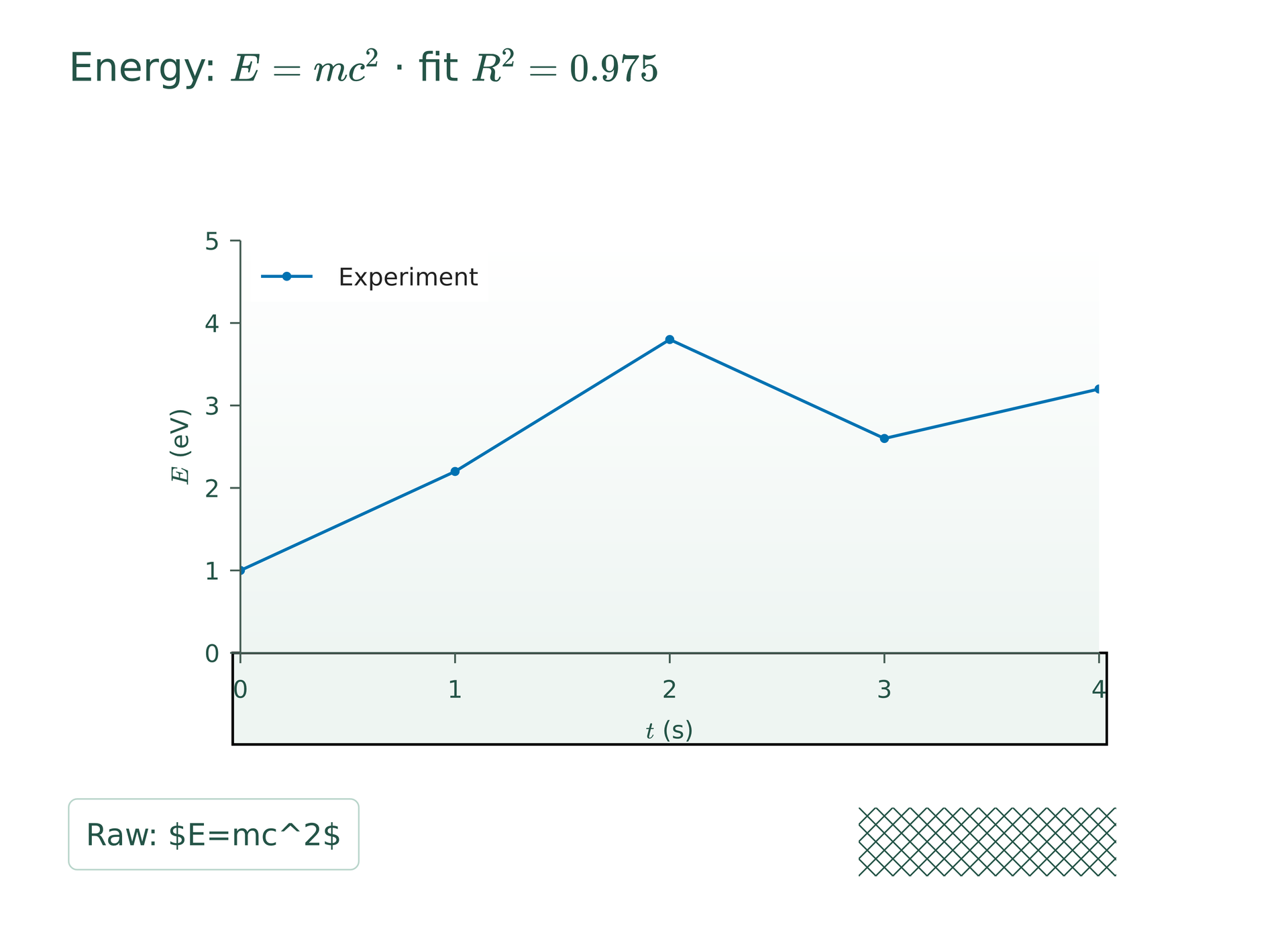
score = 0.975page.add(text(f"Energy: $E=mc^2$ · fit $R^2={score:.3f}$", class="title"), offset=(8, 5))p = plot(size=(134, 72), plot_area=box(offset=(20, 8), size=(100, 48)), x=axis(label="$t$ (s)", range=(0, 4)), y=axis(label="$E$ (eV)", range=(0, 5)))p.line(x=[0, 1, 2, 3, 4], y=[1, 2.2, 3.8, 2.6, 3.2], label="Experiment", color="#0072b2", line_width=1, marker= circle)p.legend(position= top_left)chart = page.add(p, offset=(8, 20))page.add(text(r"Raw: $E=mc^2$", class="annotation"), offset=(8, 93))page.add(rect(size=(30, 8), fill=hatch(pattern= cross, color="#245447", spacing=2)), offset=(100, 94))page = canvas(size=(150, 110), unit= mm, stylesheet="language/paper.lcss", background="#ffffff")# BEGIN DEMOscore = 0.975page.add(text(f"Energy: $E=mc^2$ · fit $R^2={score:.3f}$", class="title"), offset=(8, 5))p = plot(size=(134, 72), plot_area=box(offset=(20, 8), size=(100, 48)), x=axis(label="$t$ (s)", range=(0, 4)), y=axis(label="$E$ (eV)", range=(0, 5)))p.line(x=[0, 1, 2, 3, 4], y=[1, 2.2, 3.8, 2.6, 3.2], label="Experiment", color="#0072b2", line_width=1, marker= circle)p.legend(position= top_left)chart = page.add(p, offset=(8, 20))page.add(text(r"Raw: $E=mc^2$", class="annotation"), offset=(8, 93))page.add(rect(size=(30, 8), fill=hatch(pattern= cross, color="#245447", spacing=2)), offset=(100, 94))# END DEMOcanvas { --ink: #245447; --soft: #eef5f2; font-family: "DejaVu Sans", "Noto Sans CJK SC"; color: var(--ink);}.title { font-size: 13pt; }.annotation { font-size: 10pt; background: #ffffff; border: 0.5pt solid #b9d5cb; border-radius: 1mm; padding: 2mm;}plot::area { background: linear-gradient(to bottom, #ffffff, #eef5f2); }plot::axis { line-color: #445c53; line-width: 0.6pt; }plot::axis(x) { background: #eef5f2; }plot::legend { background: #ffffff; }Preview
Dependencies
examples/language/paper.lcssexamples/unified.lay
Loading and precedence#
canvas(stylesheet="language/paper.lcss") loads a local stylesheet; an ordered path list is also supported. Entry-file style { … } blocks follow external sheets. Specificity and source order decide ties; explicit object parameters win. Module styles are scoped to objects from their module and act as component defaults; entry themes can override them.
@import "base.lcss";plot::axis(x) { line-color: #444444; line-width: 0.6pt; }.annotation { --paper: #ffffff; background: var(--paper); border: 0.5pt solid #b9d5cb; border-radius: 1mm; padding: 1mm;}Use class="paper annotation" in .lay. Selectors support types, classes, combinations, comma-separated groups, descendants and direct children (>). Parts include plot::area, plot::axis(x), plot::tick-label, plot::axis-label, plot::legend and plot::colorbar.
Paints and borders#
fill paints a shape's interior; background paints a region. Values include none, colors, linear-gradient(...), radial-gradient(...), hatch(slash, #666666, 2mm, 0.5pt), cross/dot hatches and url("texture.png"). DSL counterparts are linear_gradient, radial_gradient, hatch and image_fill.
Configure canvas, plot frame, plot area, each axis and its labels, text/formula boxes, legends/colorbars and imported-image boxes independently. Plot-area paint follows polar outlines and visible broken-axis segments. Paint alone does not change data mapping. padding is inner spacing and contributes to measured bounds.
Closed outlines use border_*; open lines use line_*. LCSS uses hyphens, such as border-width and line-width. Typography inherits; backgrounds and placement do not. Parent and child opacity multiply. Instances of the same material can select independent classes.
Resources and limits#
LCSS lengths require explicit units (except zero), so a theme is independent of the canvas default unit. Image and font paths are relative to the declaring .lcss file. Variables support var(--name, fallback); variable and import cycles are errors.
Web layout, media queries, animation, interactive pseudo-classes and !important are unsupported and produce diagnostics. All parameters · Migration
style-properties#
Each property maps to the following DSL parameter. Types, units and inheritance use the same metadata as parameter hover.
| LCSS | DSL |
|---|---|
font-family |
font_family |
font-size |
font_size |
font-weight |
font_weight |
font-style |
font_style |
color |
color |
line-height |
line_height |
background |
background |
padding |
padding |
border-radius |
border_radius |
border-color |
border_color |
border-width |
border_width |
border-style |
border_style |
border-dash |
border_dash |
border-dash-offset |
border_dash_offset |
border-cap |
border_cap |
border-join |
border_join |
border-miter-limit |
border_miter_limit |
border-opacity |
border_opacity |
line-color |
line_color |
line-width |
line_width |
line-style |
line_style |
line-dash |
line_dash |
line-dash-offset |
line_dash_offset |
line-cap |
line_cap |
line-join |
line_join |
line-miter-limit |
line_miter_limit |
line-opacity |
line_opacity |
fill |
fill |
opacity |
opacity |
tick-font-size |
tick_font_size |
label-font-size |
label_font_size |
tick-color |
tick_color |
grid-color |
grid_color |
grid-line-width |
grid_line_width |
grid-line-dash |
grid_line_dash |
start-head |
start_head |
end-head |
end_head |
start-cap |
start_cap |
end-cap |
end_cap |
Endpoint properties accept head(...), for example end-head: head(shape=triangle,size=(5mm,4mm));. LCSS identifiers are style values; they are not reads from the DSL variable scope.
workflow#
Complete sources and executable verification fixtures for this workflow are listed in the feature coverage map. Follow this page’s input conditions and limits when composing features.