 LayMesh
CSS gradients and layered backgrounds#
Comparison gallery: original recipes, actual exports and reference differences
Paint constructors · Open Props · Property reference
Geometry and stops#
gradient(css="...") and CSS paints accept linear-gradient, radial-gradient, conic-gradient and all three repeating-* forms. Geometry follows CSS Images. Linear directions include angles and to top right; radial shapes accept circles, ellipses, explicit dimensions and closest/farthest side/corner sizes. Centers can lie outside the object. Conic zero points upward and angles increase clockwise.
Linear/radial stops accept physical lengths and percentages. Conic stops accept percentages and deg, rad, grad, turn, including mixed calc() expressions. A color can have two positions; coincident positions preserve hard edges. Omitted positions are distributed after stop fixup. Midpoint hints use the standard power curve. Negative and greater-than-100% positions are retained until the final geometry is known. Repetition keeps the first-to-last stop interval and phase; zero-length repetitions use the specified average-color rule.
Lengths use layout_dpi, current/root font size and canvas dimensions. Export DPI never changes layout. linear_gradient and radial_gradient keep their existing normalized-coordinate API. conic_gradient(stops=...,center=(0.5,0.5),angle=0deg) adds the same reusable paint interface; use gradient(css=...) for the complete stop grammar.
Color interpolation#
The in <space> clause supports srgb, srgb-linear, display-p3, display-p3-linear, a98-rgb, prophoto-rgb, rec2020, xyz/xyz-d65, xyz-d50, lab, lch, oklab, oklch, hsl and hwb. Polar spaces accept shorter, longer, increasing and decreasing hue. Missing components and premultiplied alpha follow CSS Color 4.
Source channels stay floating point through interpolation. Gamut mapping occurs afterwards, into the sRGB output surface. Legacy RGB/named/HSL/HWB colors default to sRGB interpolation; modern colors default to OKLab. Rust resolves colors and adaptively samples complex interpolation, preserving duplicate stops at hard edges. Native Skia and CanvasKit consume that same result. Custom color profiles and morphing between gradient paints are outside this interface.
Layered backgrounds#
.card { background-color: #f8fafc; background-image: linear-gradient(90deg,#f008,transparent), url("texture.png"); background-size: auto, cover; background-position: center, right bottom; background-repeat: no-repeat;}The first image is on top; the color is below all images. Image, position, size and repeat lists match by index, repeating shorter lists and ignoring unused values. A none image still occupies a layer. background resets its components and permits the color only in the final layer. Invalid declarations do not erase earlier valid declarations.
background-size supports one/two length-percentages, auto, cover and contain. background-position supports percentages, lengths, axis keywords and edge offsets. background-repeat supports repeat, no-repeat, repeat-x, repeat-y, space, round and separate axis values. The positioning area remains the LayMesh object's layout box; its path and rounded corners clip the layers. Object opacity, border and shadow apply once. Browser scrolling, attachment, padding/content-box positioning and clipping models are not introduced.
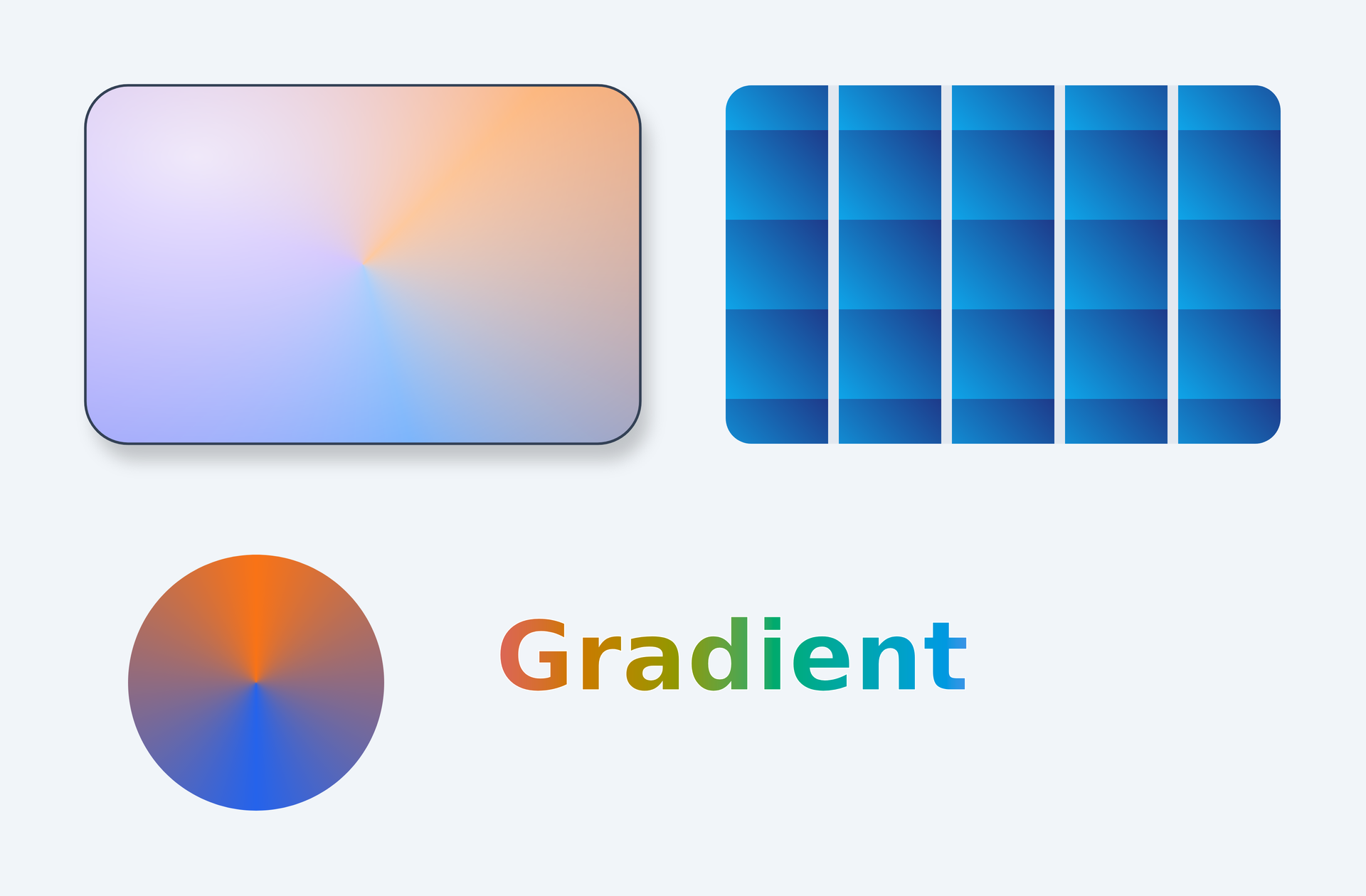
page=canvas(size=(160mm,105mm),background="#f1f5f9")style { .card { background:radial-gradient(at 20% 20%,#ffffffcc,transparent),conic-gradient(from 45deg in oklab,#fb923c,#60a5fa,#a78bfa,#fb923c) #ffffff;border-radius:5mm;border:0.3mm solid #334155;box-shadow:1mm 2mm 2mm #0003; } .tiles { background:linear-gradient(45deg,#0ea5e9,#1e3a8a) center / 12mm 10mm space round #e2e8f0;border-radius:3mm; }}page.add(rect(size=(65mm,42mm),class="card"),offset=(10mm,10mm))page.add(rect(size=(65mm,42mm),class="tiles"),offset=(85mm,10mm))wheel=conic_gradient(stops=[(0,"#f97316"),(0.5,"#2563eb"),(1,"#f97316")])page.add(ellipse(size=(30mm,30mm),fill=wheel,border_width=0),offset=(15mm,65mm))ink=gradient(css="linear-gradient(to right in oklch longer hue,oklch(65% .15 30),oklch(65% .15 250))")page.add(text("Gradient",font_family="DejaVu Sans",font_size=32pt,font_weight=700,text_fill=ink,text_stroke_color="#ffffff",text_stroke_width=0.3pt),offset=(58mm,70mm))Preview
Dependencies
examples/manual/gradient-composition.lay
Preview and export#
Native previews, VS Code, the website and offline HTML use Skia gradient shaders. Display-list version 2 introduced conic paints. The current version is 3 (object effects); readers still accept versions 1 and 2, and changing versions replaces the incremental baseline.
SVG/PDF/PPTX preserve representable vectors. Unsupported fills are rasterized locally at the selected export DPI; ordinary text and outlines retain their existing output paths. Normal fallback is silent. Raster regions are tiled under the existing memory budget; impossible dimensions and failed output remain errors. Technical raster details are kept in export jobs and PPTX object names rather than per-object warnings.
When a target cannot represent isolated opacity on overlapping fill and stroke, that object's composition is rasterized together to apply opacity once. Other objects remain independent. The offline playback PDF path checks the error of its PDF library's sampled shading functions and uses local fill fallback when they cannot preserve the resolved colors.
The verification harness is scripts/test-gradient-parity.cjs. It preserves original library CSS and records browser version, sRGB conditions, engine/library hashes, editable inputs and actual outputs. Browser approximations can differ from the standard formulas: Chromium's midpoint hints use nine inserted stops. Such differences must be reported separately from a passing pixel comparison.